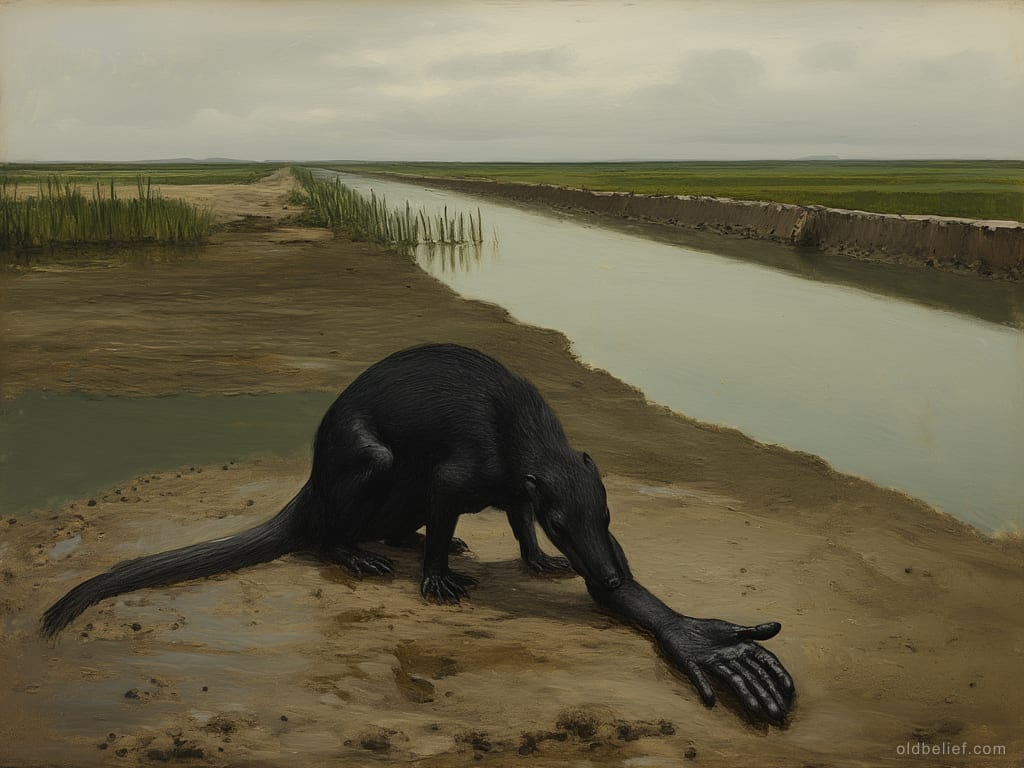
Book 11 puts it between creatures that can be caught and eaten, and describes it as dryly as any of them: about the size of a small dog, black and smooth as rubber. The only thing out of place is the hand at the end of the tail.
Basis: Florentine Codex, Book 11, folio 71r · AI-generated
About the Ahuitzotl
A small black water animal with a hand at the end of its tail, described in a sixteenth-century natural history among the otters and the frogs, and credited with pulling people under.
Bernardino de Sahagún, Florentine Codex: General History of the Things of New Spain, Book 11 (Earthly Things) (1577)Folio 71r. The description (small, black, smooth as rubber, small pointed ears, a long tail ending in a hand) and the account of what happens to a body it has taken. The primary source, and effectively the only one.
Kim N. Richter and Alicia Maria Houtrouw (eds.), Digital Florentine Codex (2023)Digital facsimile and transcription of the 1577 manuscript, which makes the Nahuatl text and the illustration of folio 71r directly checkable.